 CONSUMER SERVICES

Rahul Poral - December 16, 2025
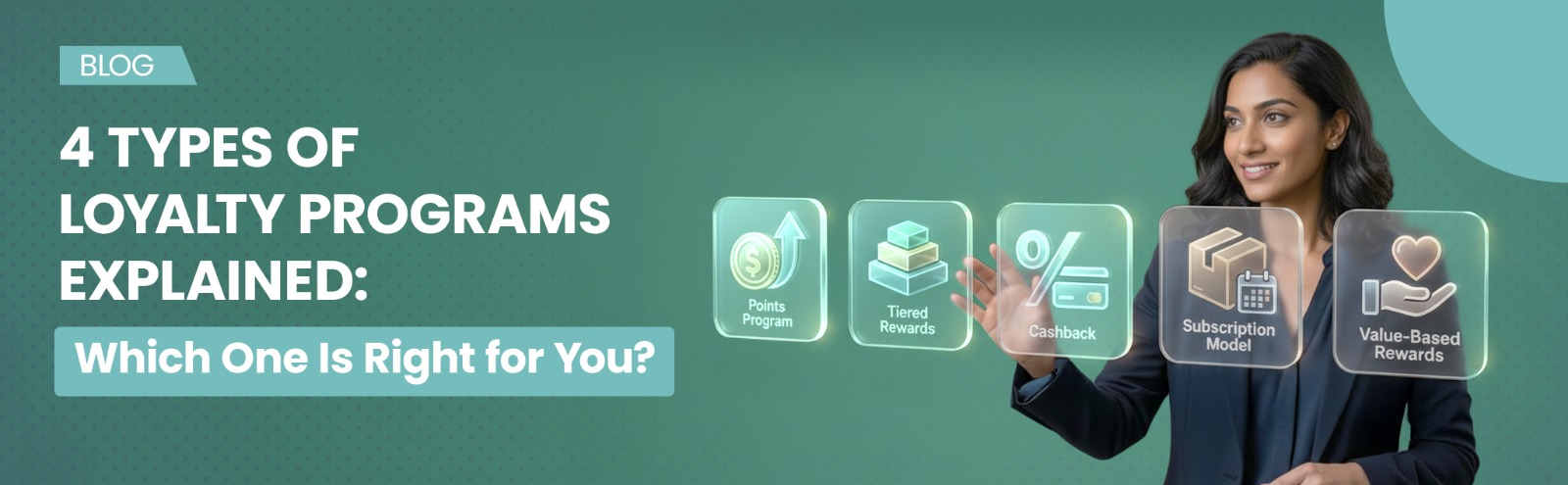

For years, loyalty has been discussed through mechanics — points, cashback, tiers, gamification. That lens is outdated when viewed through the broader lens of types of Loyalty Programs.
Customers don’t experience loyalty as a “format.”
They experience it as relevance.
A retailer, a sales rep, an influencer, and an end consumer are motivated by completely different things. Treating them with the same loyalty logic is why most programs underperform — they reward activity but fail to change behaviour.
Modern loyalty strategy should start with who you’re influencing, not how you’re rewarding. Customer loyalty program types and broader loyalty program models matters.
At scale, loyalty programs fall into four meaningful categories:
-Customer Loyalty
-Trade Loyalty
-Sales Loyalty
-Influencer Loyalty
Each exists to solve a different business problem. Each requires a fundamentally different design philosophy.
Customer loyalty is often mistaken for repeat purchase incentives. In reality, it’s about retention, frequency, and emotional stickiness over time.
Strong customer loyalty programs:
-Reward behavior, not just spend
-Create reasons to engage even between purchases
-Use data to personalize journeys, not blast offers
The mistake most brands make is over-indexing on transactional rewards. Discounts drive the next purchase; they don’t build loyalty. Programs that last are those that combine rewards with progress, access, recognition, and experience.
Customer loyalty works best when it:
-Nudges frequency (not just basket size)
-Recognizes milestones and tenure
-Evolves as customers mature with the brand
If your customer loyalty program can be paused without impacting behaviour, it’s not loyalty — it’s promotion.
Trade loyalty is not a sales scheme. It’s a preference engine.
Distributors, retailers, and channel partners don’t lack incentives — they lack reasons to prioritise your brand over the next one offering a margin bump.
Effective trade loyalty programs:
-Reward consistency, range, and compliance — not just volume
-Shift behavior at the shelf, not just at billing
-Create long-term partner stickiness beyond quarterly targets
The biggest flaw in trade programs is linear thinking: sell more, earn more. That logic ignores the realities of distribution — limited shelf space, working capital constraints, and competing brand pressures.
Well-designed trade loyalty:
-Uses milestones, tiers, and challenges to shape behavior
-Rewards actions like visibility, assortment mix, and advocacy
-Builds habit loops across the selling cycle
Trade loyalty is successful when partners choose you even when incentives are equal.
Sales loyalty is often reduced to targets and payouts. That’s a mistake.
Sales teams don’t disengage because incentives are low — they disengage when effort feels invisible, progress feels slow, and rewards feel distant.
High-impact sales loyalty programs:
-Reward momentum, not just outcomes
-Create short-term wins alongside long-term goals
-Use recognition and progression as motivators, not only cash
The most effective sales programs borrow heavily from behavioral design:
-Streaks to drive consistency
-Micro-milestones to maintain motivation
-Leaderboards that encourage healthy competition, not burnout
Sales loyalty should answer one question clearly for every participant:
“What do I get for trying harder today?”
If your program only rewards the top 10%, it’s not driving performance — it’s reinforcing hierarchy.
Influencer loyalty is the most misunderstood — and most underutilised — category.
Most brands still treat influencers as campaign vendors. The result? Transactional relationships, inconsistent output, and zero long-term brand advocacy.
Influencer loyalty programs flip the model:
-From one-off payouts to ongoing value exchange
-From reach-first thinking to relationship-first thinking
-From reach-first thinking to relationship-first thinking
Strong influencer loyalty programs:
-Reward consistency, quality, and brand alignment
-Offer access, recognition, and exclusivity — not just fees
-Build long-term creator-brand partnerships
The goal is not to buy posts.
The goal is to build a creator ecosystem that grows with the brand.
When influencers feel invested, content improves, advocacy deepens, and acquisition costs drop over time.
Role-based loyalty shows up differently across sectors — but the principle remains the same: design loyalty around behaviour, not mechanics.
Customer loyalty drives repeat purchases and basket expansion, while trade loyalty ensures shelf visibility, distribution depth, and brand preference across stores.
Customer loyalty focuses on usage frequency and cross-product adoption, while sales loyalty motivates relationship managers and field teams to push the right products at the right time.
Trade loyalty influences partner commitment and portfolio share, while sales loyalty keeps internal teams engaged across long deal cycles.
Customer loyalty builds community and repeat engagement, while influencer loyalty creates always-on advocacy instead of one-off campaign spikes.
Loyalty is split between customer frequency programs and sales or partner programs that ensure service quality and upsell consistency.
As complexity increases, leading brands run multiple loyalty programs in parallel, each tailored to a specific audience but connected by shared data, rewards, and intelligence.
The most common mistake brands make is asking: “Which loyalty format should we run?”
The right question is: “Whose behaviour are we trying to change?”
-If the goal is repeat purchase and retention, customer loyalty is the foundation.
-If the goal is distribution push, shelf visibility, or partner preference, trade loyalty is essential.
-If the goal is sales productivity and motivation, sales loyalty needs to go beyond targets and payouts.
-If the goal is authentic reach and brand advocacy, influencer loyalty must replace campaign-only thinking.
In many cases, the answer isn’t one program — it’s a portfolio of loyalty programs, each designed for a different role but aligned to the same business outcomes.
The format is never the starting point. The behavior is.
The future of loyalty isn’t about choosing between points or cashback. It’s about designing role-specific behaviour systems that align incentives with business outcomes.
Most high-performing brands today don’t run a loyalty program.
They run multiple loyalty programs, each designed for a different audience — but connected by data, logic, and measurement.
The winning question is no longer:
“What type of loyalty program should we run?”
It’s: “Whose behavior are we trying to change — and what will genuinely motivate them?”
BigCity approaches loyalty from a behavior-first lens. Instead of starting with mechanics, we start with:
-The audience (customer, trade, sales, influencer)
-The behavior to be influenced
-The frequency and lifecycle of that behavior
-The reward logic that will sustain it over time
With experience across thousands of programs, BigCity builds modular loyalty ecosystems that:
-Support multiple loyalty types simultaneously
-Adapt across industries and roles
-Integrate rewards, data, gamification, and fulfilment seamlessly
-Evolve as behavior and business priorities change
The result isn’t a loyalty program.
It’s a loyalty strategy that compounds value over time.
A promotech company specializing in tactical and loyalty campaigns, offering Retailer Programs, Influencer Programs, Distributor Programs, and Sales loyalty Programs. We leverage rewards, engagement-based technology, and loyalty strategies backed by AI and insights.










© 2026 Premier Sales Promotions Pvt. Ltd. All rights reserved.
 TRADE PLATFORMS