 CONSUMER SERVICES

Rahul Poral - December 22, 2025
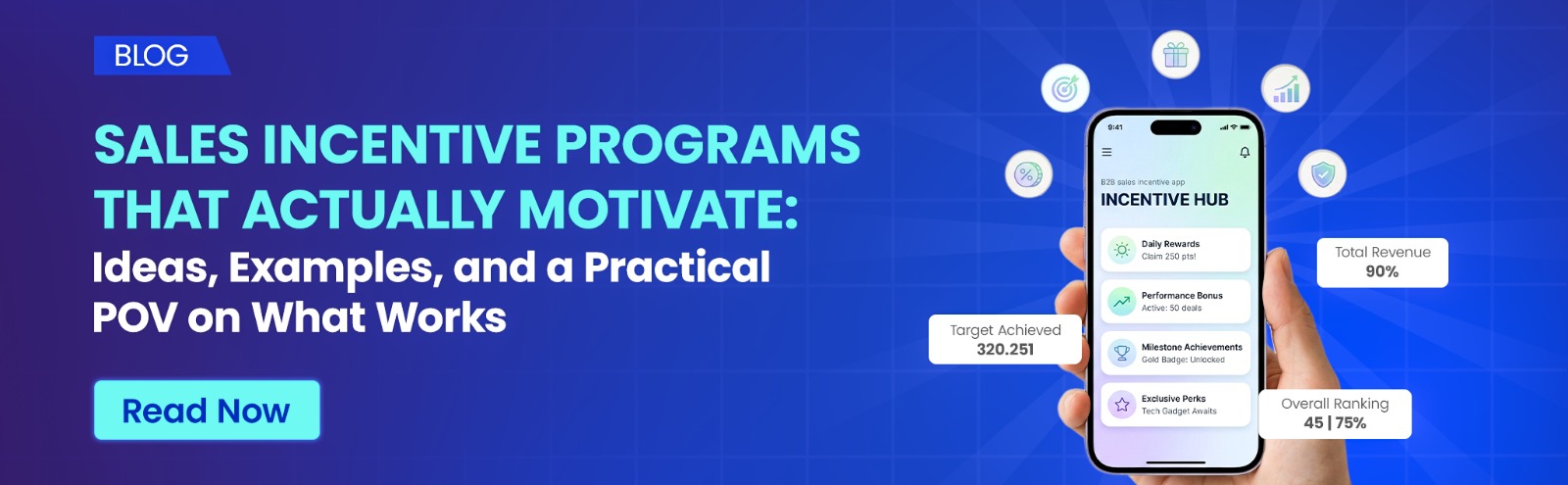

Sales incentive programs are everywhere.
Sales motivation is not.
Most sales incentive schemes fail for a simple reason: they reward outcomes without understanding behaviour. They assume money alone drives performance. It doesn’t.
The best sales incentive programs don’t just pay more.
They change daily actions, decision-making, and momentum.
This piece breaks down how to design sales incentive programs that truly motivate—across channel partners, distributors, field force, and internal sales teams—without turning into noise or entitlement.
At its core, a sales incentive program works when it taps into three psychological drivers:
People work harder when they see themselves moving forward, even if the final reward isn’t massive. Progress bars, milestones, and tier movement outperform large, distant bonuses.
Leaderboards, badges, public recognition, and “top performer” visibility create behavioural pull—especially in competitive sales environments.
A ₹10,000 reward delivered instantly often motivates more than a ₹10,000 reward delivered three months later. Delayed gratification kills momentum.
Different sales ecosystems need different incentive logic.
– Daily wins
– Peer comparison
– Clear effort-to-reward mapping
– Weekly goals
– Micro-incentives
– Gamified task completion (coverage, visibility, compliance)
– Incentives tied only to monthly numbers
– Zero feedback between start and payout
– Growth
– Visibility
– Career signaling
– Skill-based incentives (upsell, cross-sell, quality)
– Leaderboards with multiple winning paths
– Non-cash rewards that feel aspirational
– Pure commission thinking
– Incentives that reward volume but ignore quality
Strong sales incentive program ideas balance financial and emotional value. But more importantly, they focus on relevance over absolute value. A reward only motivates when it feels useful, aspirational, or timely to the recipient.
Instead of one finish line, create multiple reachable peaks.
Example:
– Bronze: Achieve baseline → instant reward
– Silver: Stretch target → premium reward
– Gold: Consistency + growth → experiential or high-status reward
Why it works:
It motivates both average and top performers—without demotivating the middle.
Break the journey into checkpoints.
Examples:
– First 10 conversions
– First ₹X in revenue
– First regional target achieved
Why it works:
Momentum compounds when effort is rewarded early.
Leaderboards work best when they:
– Reset frequently
– Have multiple categories (not just revenue)
– Reward participation, not only rank #1
Smart twist:
Run parallel leaderboards—growth %, consistency, new accounts—not just absolute numbers.
A sales incentive program doesn’t fail because the reward isn’t attractive. It fails because the design doesn’t align with how sales teams operate in the real world. The difference between a program that drives behaviour and one that gets ignored lies in a few fundamental design choices.
If participants have to ask whether they qualify, the program has already lost momentum. Eligibility needs to be immediately understandable—who is included, what actions count, and how success is measured. Simple rules drive higher participation than complex, “perfect” logic. At scale, clarity always outperforms complexity.
Incentives tied only to monthly or quarterly outcomes assume motivation will last on its own. It rarely does. Programs work better when they reward progress, not just end results. Smaller, more frequent wins keep energy high and reinforce effort, while long-term rewards should act as accelerators—not the only reason to participate.
Most incentive programs don’t fail at launch—they fade due to silence. Regular visibility, progress updates, and recognition keep incentives top-of-mind. When people see movement and winners, motivation spreads naturally. If a program isn’t being talked about, it isn’t working.
The easier a program is to participate in, the more effective it becomes. Manual processes, delayed rewards, or unclear tracking weaken trust quickly. The best incentive programs run quietly in the background—allowing sales teams to focus on selling, not on managing the incentive itself.
A sales incentive program doesn’t fail because the reward isn’t attractive. It fails because the design doesn’t align with how sales teams operate in the real world. The difference between a program that drives behaviour and one that gets ignored lies in a few fundamental design choices.
Sales incentive programs are often judged on a single metric: did sales go up? While uplift matters, it’s a lag indicator. By the time revenue shifts, it’s usually too late to fix what isn’t working within the program.
Stronger signals appear much earlier—in participation and behaviour. High enrolment, consistent activity, and repeat engagement indicate that the program is driving effort, not just rewarding outcomes. If engagement is limited to top performers, the incentive is likely reinforcing existing performance rather than creating new growth.
Momentum drop-offs matter just as much. Tracking time to first reward, points of disengagement, and ignored milestones reveals friction early. These insights allow teams to refine thresholds, cadence, or communication before performance is impacted.
The most effective incentive programs are continuously optimised, not set and forgotten. Treated as living systems, they evolve with data—turning rewards from a cost line into a predictable performance lever.
At BigCity, the belief is simple:
Incentives are not about rewards. They are about behaviour design.
The most effective programs are built at the intersection of:
– Clear goals
– Human motivation
– Operational simplicity
– Measurable outcomes
Whether it’s channel sales, field execution, or internal teams, incentive programs work best when they are easy to participate in, hard to ignore, and rewarding without being wasteful.
Because when incentives feel fair, visible, and achievable performance follows.
A promotech company specializing in tactical and loyalty campaigns, offering Retailer Programs, Influencer Programs, Distributor Programs, and Sales loyalty Programs. We leverage rewards, engagement-based technology, and loyalty strategies backed by AI and insights.










© 2026 Premier Sales Promotions Pvt. Ltd. All rights reserved.
 TRADE PLATFORMS