 CONSUMER SERVICES

Rahul Poral - February 17, 2026
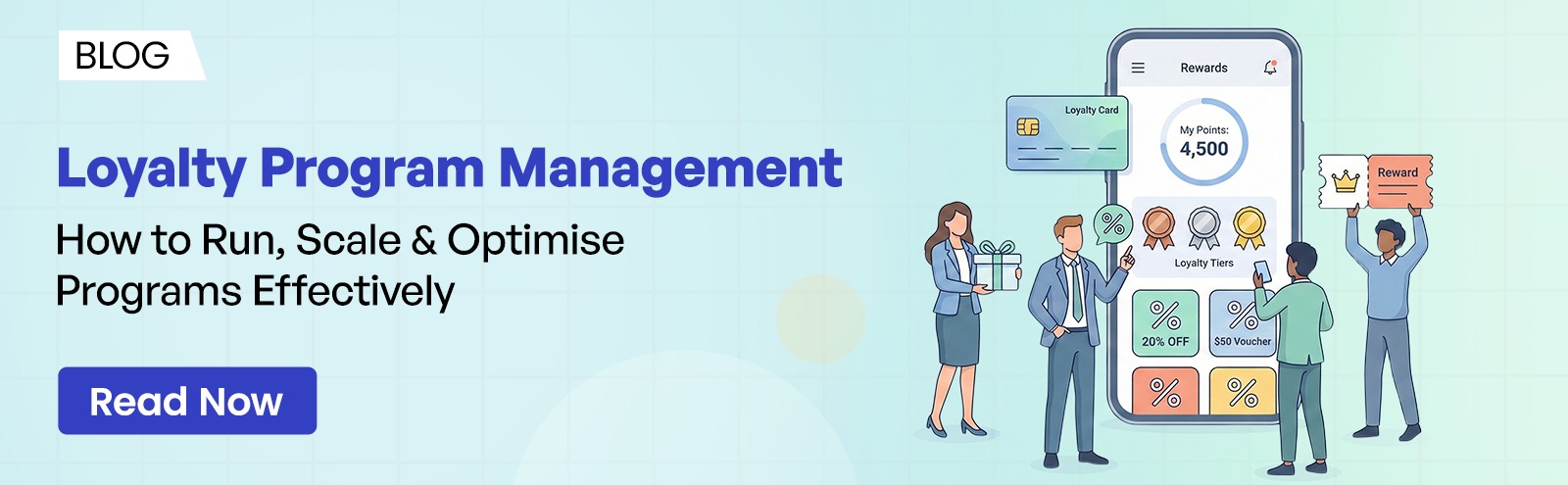

Loyalty programs have evolved far beyond point accumulation and discount-led mechanics. Today, they are complex business ecosystems that influence behaviour, drive repeat revenue, and generate first-party data at scale. Yet, many programs underperform—because of lack of technology, and weak loyalty program management.
True success lies not just in launching a loyalty program, but in how effectively it is run, scaled, and continuously optimized.
Loyalty program management is the strategic and operational discipline of designing, operating, measuring, and evolving a loyalty program to consistently drive business outcomes.
It goes far beyond software dashboards, points engines, or reward catalogues. At its core, loyalty program management is about shaping behaviour, delivering value at scale, and aligning incentives with long-term brand growth—while ensuring operational efficiency and measurable ROI.
In simple terms, it’s the difference between having a loyalty program and making it work.
In reality, loyalty program management is not a single function—it’s a combination of strategy, technology, rewards, and execution working in sync. At BigCity, we see successful programs being managed across four core areas:
Effective loyalty programs are built around specific business behaviors—repeat purchase, higher frequency, sustained engagement, or channel stickiness. This means defining what action to reward, when to reward it, and how frequently to reinforce it.
Program management here involves continuously refining mechanics—points, tiers, milestones, gamification, or instant rewards—to ensure the program drives incremental behaviour, not just participation.
Loyalty programs today run across multiple touchpoints—QR codes, apps, microsites, WhatsApp, in-store, and CRM systems. Managing this requires a stable, scalable technology layer that can track actions in real time, trigger rewards accurately, and integrate seamlessly with existing brand systems.
Poor tech execution leads to broken journeys, delayed rewards, and loss of trust—one of the biggest reasons loyalty programs drop off.
Rewards are where loyalty becomes real for the end user. Program management involves curating relevant reward catalogues, managing inventories, handling fulfilment, ensuring timely redemptions, and resolving issues quickly.
This also includes managing reward partners, controlling costs, preventing misuse, and ensuring rewards remain aspirational as the program scales.
Every loyalty program generates rich first-party data—but only if it’s managed well. This includes tracking participant behaviour, redemption patterns, cohort performance, and incremental business impact.
Strong program management ensures brands can clearly answer:
What behaviour changed? What did it cost? And what value did it deliver?
Without this layer, loyalty becomes an expense—not an investment.
Start with clarity. Is the objective retention, frequency, data capture, upsell, or channel loyalty? A program without a defined goal quickly turns into a cost centre.
Design based on how customers actually behave, not how brands wish they would. Use data to identify high-value actions and incentivise those moments meaningfully.
Pilot with a focused audience, limited mechanics, and controlled rewards. Learn fast, optimise early, and scale with confidence—rather than launching large and fixing later.
Complex rules reduce participation. Customers should understand how to earn and redeem rewards within seconds. Simplicity drives engagement; confusion kills it.
Rewards should feel aspirational yet achievable. Over-rewarding erodes margins; under-rewarding kills motivation. The right mix of instant gratification and milestone-based rewards works best.
No brand needs to build everything alone. Strategic reward, tech, and alliance partners help expand value without inflating costs—while improving customer relevance.
Continuous optimization is non-negotiable. Track behaviour change, cost efficiency, and ROI. Use insights to refine mechanics, rewards, and communication—quarter after quarter.
Loyalty programs don’t fail because customers don’t want them. They fail because brands underestimate the discipline required to manage them effectively. When managed strategically, loyalty becomes more than a program—it becomes a growth engine. The brands that win are those that treat loyalty not as a campaign, but as a long-term business capability.
A promotech company specializing in tactical and loyalty campaigns, offering Retailer Programs, Influencer Programs, Distributor Programs, and Sales loyalty Programs. We leverage rewards, engagement-based technology, and loyalty strategies backed by AI and insights.











© 2026 Premier Sales Promotions Pvt. Ltd. All rights reserved.
 TRADE PLATFORMS