 CONSUMER SERVICES

Rahul Poral - March 11, 2026
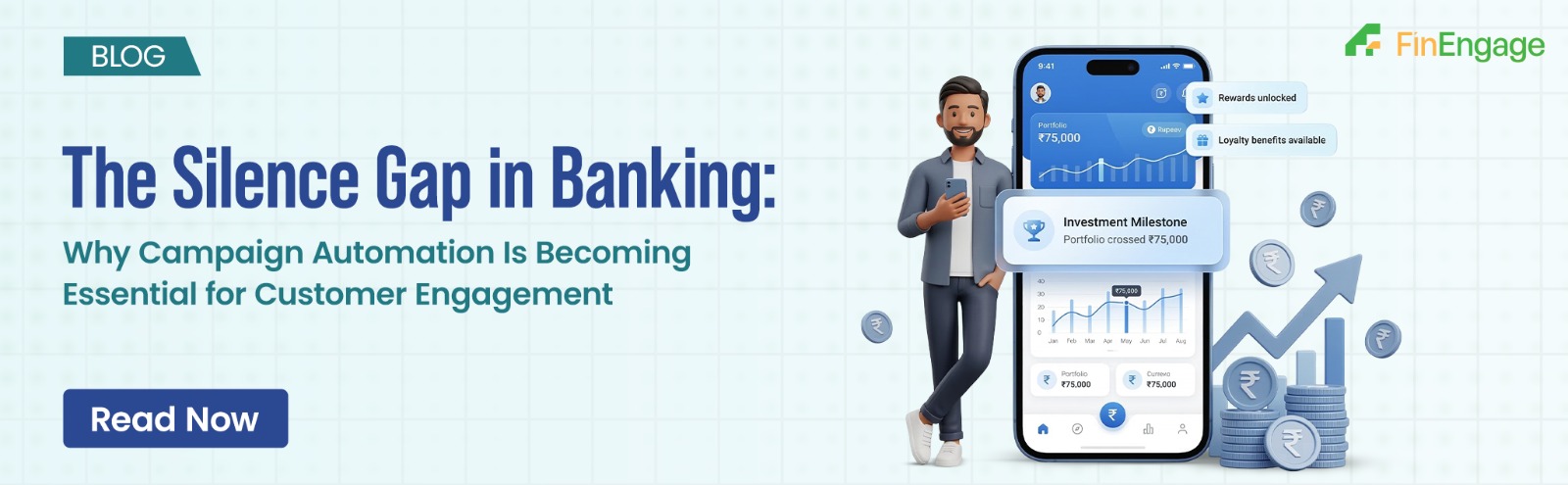

Banks today sit on an extraordinary amount of customer data. Every transaction, balance change, login, and payment generates insight into how customers behave.
Yet, for all this intelligence, there is often a surprising silence in how banks engage.
-A customer’s savings balance steadily grows but no wealth offer appears.
-A credit card holder stops transacting but receives no meaningful nudge.
-A customer begins paying a loan EMI to another bank without triggering any engagement response.
These signals exist inside the bank’s systems. But in many cases, nothing happens.
Most banks tend to activate customer engagement only around specific occasions — onboarding, festive campaigns, product launches, or collections — leaving long stretches of the customer journey largely silent.
This is what can be called the “silence gap” in the customer journey — long periods where customer behaviour is generating valuable signals, but the bank isn’t acting on them.
And those quiet gaps are often where customers slowly drift away.
Most banks already have access to rich behavioural data. The issue is not visibility — it is action.
Customer signals are captured in core banking systems, transaction logs, and analytics dashboards. But turning those signals into real-time engagement often requires multiple manual steps.
-Marketing teams need to identify the behaviour pattern.
-Technology teams need to configure triggers.
-Reward mechanics and communication journeys must be coordinated across different platforms.
By the time a campaign is created and deployed, the moment that mattered may already have passed.
Customer behaviour, however, does not wait for campaign timelines. It happens continuously — and the ability to respond at the right moment is what increasingly determines whether a bank deepens engagement or loses relevance.
Historically, banks approached engagement through large promotional campaigns.
Festive cashback offers, credit card spend promotions, digital banking adoption campaigns — these efforts are designed to create bursts of activity.
But they do not solve the everyday engagement problem.
The most important behavioural shifts in banking happen through small actions repeated over time:
-The first card transaction.
-The habit of paying bills digitally.
-Regular savings transfers.
-Consistent card usage.
These behaviours rarely form because of a single campaign. They develop through timely nudges and reinforcement at the right moments.
Without a system that continuously responds to customer behaviour, banks end up relying on broad campaigns that treat all customers the same. And in a highly personalised digital economy, that approach is quickly losing effectiveness.
Campaign automation changes this equation by connecting customer behaviour directly to engagement triggers.
Instead of launching periodic campaigns, banks can build automated journeys that respond instantly to customer actions.
For example:
-A new account opening can trigger an activation journey encouraging the first transaction.
-A credit card issuance can initiate milestone rewards for the first few spends.
-A drop in transaction activity can automatically trigger a reactivation incentive.
-A balance threshold can prompt investment or savings product engagement.
These interactions happen automatically, without waiting for manual campaign creation.
Automation essentially acts as the bank’s engagement nervous system — continuously listening to customer behaviour and responding with the right nudge.
This ensures that banks are not just observing customer activity, but actively guiding it.
Beyond improving campaign efficiency, automation fundamentally changes how banks manage engagement.
First, it enables real-time responsiveness. Engagement can be triggered at the exact moment behaviour occurs, dramatically increasing relevance and response rates.
Second, it allows banks to scale engagement across millions of customers. Instead of manually managing individual campaigns, automated journeys operate continuously in the background.
Third, it helps create structured customer journeys rather than isolated promotions. Customers can move through activation, adoption, and usage milestones through automated engagement flows.
Finally, automation provides clear visibility into behavioural outcomes. Banks can track which triggers are working, where customers drop off, and which engagement journeys drive product adoption.
In other words, automation transforms engagement from a marketing activity into an operational capability.
This is the foundation behind FinEngage’s Campaign Automation Platform.
FinEngage enables banks to design automated engagement journeys triggered by real-time behavioural events — from account creation and card issuance to transaction milestones and inactivity patterns.
Once configured, the platform executes these journeys automatically.
Rewards, triggers, campaign execution, and performance tracking operate within a single system, allowing banks to manage engagement programs without the operational complexity of multiple disconnected tools.
For marketing teams, this creates a much more scalable engagement model.
Instead of constantly planning new campaigns, they can design behaviour-led journeys that run continuously — ensuring customers are guided through critical lifecycle moments.
The silence gap in banking is not caused by a lack of data. It exists because many institutions still lack the systems to translate behavioural signals into immediate action.
Campaign automation provides that missing layer.
By turning customer behaviour into automated engagement triggers, banks can ensure that important moments in the customer journey never pass unnoticed.
And in a digital-first financial ecosystem where customer attention shifts quickly, the ability to respond instantly may well become the defining factor between passive account holders and deeply engaged customers.
A promotech company specializing in tactical and loyalty campaigns, offering Retailer Programs, Influencer Programs, Distributor Programs, and Sales loyalty Programs. We leverage rewards, engagement-based technology, and loyalty strategies backed by AI and insights.











© 2026 Premier Sales Promotions Pvt. Ltd. All rights reserved.
 TRADE PLATFORMS